

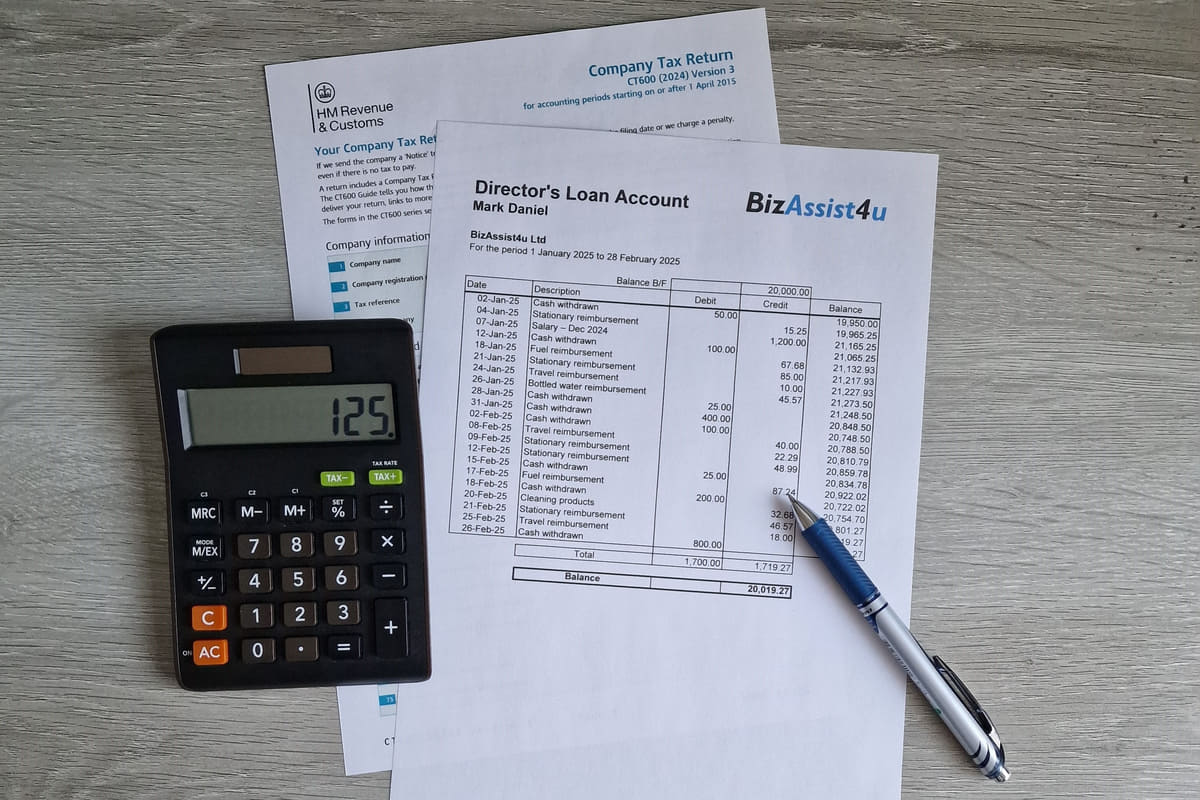
It is not uncommon for small business owners or directors to pay for personal expenses using business funds. This is sometimes done on purpose (when the director needs extra money) or by accident (such as paying for personal expenses using your business card by mistake). This can lead to a situation where you owe your business money, or in accounting terms, you have an overdrawn Director’s Loan Account.
Alternatively, you may have lent your business money (as in a loan between you personally and your business). When your business owes you money, it is said that your Director’s Loan Account is in credit.
This post is intended as a general guide on things to consider regarding your Director’s Loan Account.
When Your Business Owes You Money – Director’s Loan Account in Credit
It is very common for owners of a limited company to put some of their personal money into their limited company. This is often the case when you initially set up your company, as some funds may be required before it receives income. This is in addition to the share capital you may have paid.
You can lend money to your limited company on an interest-free basis to be repaid at a later date.
Alternatively, you can charge your company interest on the loan. Some points to note include:
- Loan Agreement – You should create a loan agreement between you and your company. This should include the effective date of the loan, loan principal amount, interest rate, term of the loan, and any other conditions.
- Business Expense – For your company, the interest paid to you is an allowable tax-deductible business expense for Corporation Tax.
- Interest as Income – The interest you charge your company on the loan counts as personal income for you. You must report this income on your personal Self Assessment tax return.
- Tax Deductions – Your company must deduct the basic rate of Income Tax (20% for the 2025-26 tax year) from the interest amount before paying it to you. The company must report and pay the Income Tax every quarter using form CT61.
- Interest Rate – The interest rate you can charge your UK Ltd company on a loan is not strictly regulated, but it should be reasonable and reflect market rates to avoid any issues with HMRC. Typically, the interest rate should be comparable to what the company would pay if it borrowed from a bank or other financial institution.
For more information, visit Director’s loans – If you lend your company money
Some other points to consider:
- If you lend money to your business, you can take the loan principal back out of the business at any time with no tax consequences, as it is just a repayment of a loan.
- If you are going to charge interest on the loan, you ideally want to leave all the money in the business for a reasonable amount of time. This is because if you put money in and take money out randomly, it will make it difficult to administer the loan, as you would be calculating interest on an ever-changing principal amount.
When You Owe Your Business Money – Overdrawn Director’s Loan Account
Okay, so this one you need to be a bit careful with.
You can borrow money personally from your limited company.
Here are some key points to consider:
- Loan Agreement – It’s advisable to create a formal loan agreement detailing the terms, interest rate, and repayment schedule. This ensures transparency and compliance with legal requirements.
- Shareholder Approval – For loans over £10,000, you may need to get approval from the shareholders, as required by the Companies Act. For a small company, you may be the only shareholder, so it’s not a big deal.
- Director’s Loan Account – Any money you borrow from or pay into the company should be recorded in a Director’s Loan Account. This account keeps track of all transactions between you and the company.
- Tax Implications – If the loan exceeds £10,000 and is either interest-free or at a lower interest rate than the official rate, it will be considered a taxable benefit in kind. This means you’ll need to report it on your personal tax return, and the company will have to pay National Insurance on the benefit.
- Corporation Tax – If the loan is not repaid within 9 months of the end of the company’s accounting period, the company will have to pay s455 Corporation Tax at 33.75% (for the 2025-26 tax year) on the outstanding amount. This tax can be reclaimed once the loan is repaid.
Just to clarify – if you borrow £10,000 or less from your company:
- You typically don’t need to get shareholder approval.
- You can borrow the money interest-free without any personal tax implications, but it might be wise to charge an interest rate at least equal to the official rate to avoid potential issues with HMRC.
- It won’t be considered a taxable benefit in kind, so you won’t need to report it on your personal tax return.
- Again, if you don’t repay the loan within 9 months of the end of your company’s accounting period, the company will have to pay s455 Corporation Tax on the outstanding amount.
For more information, visit Director’s loans – If you owe your company money
Startup Strategies – Optimising Share Capital and Director’s Loans
Let’s take the scenario of you starting a business and you are about to incorporate your limited company. You will need to decide how many shares you want your business to have and the cost of each share – this will be your capital that you will inject into the business. You may be thinking that you will set the business up with 100 shares, for example.
You may have budgeted to put £10,000 into the business at startup for running the business until such time as you start to earn revenue. In this case, you may be tempted to set the share price at £100 per share, being 100 shares times £100 per share, which will equal your £10,000 in total for all shares.
A better strategy may be to set the share price to, say, £1 per share, being 100 shares times £1 per share, which will equal £100 in total for all shares.
You would still put £10,000 into the business, but it would be allocated as below:
- Share capital – £100.
- Loan to business – £9,900.
This will allow you to charge interest on the money you have lent your company if you want and also makes it very easy to withdraw the £9,900 loan principal from the business at any time without any tax implications for you personally as it can be coded as a loan repayment back to you.
This strategy will not be right for everyone, but it is something for you to think about. One example where this might not be the best strategy is if you intend to grow a large business and may want to sell shares in your company to raise capital. A potential investor will likely want to see that you have personally invested a reasonable amount of capital into the business that is intended to stay in the business, rather than a loan that you could draw out at any time.
Summary
It is not a problem if you lend your limited company money, and it does not matter for how long. When you are borrowing money from your company, you need to be more careful and especially be mindful of when you will be paying back the money to avoid additional tax issues.
Need Help Managing Your Business Bookkeeping – Contact Us Today!

Disclaimer: The content on our site is for general information only and not professional advice. Always seek professional guidance before acting on any information here. While we strive for accuracy, we cannot guarantee completeness or timeliness of the content.